
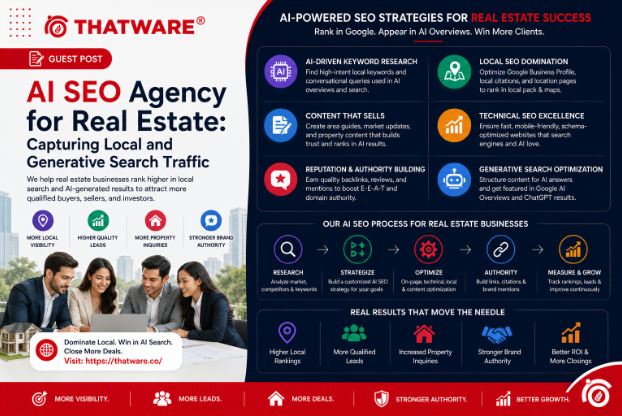
Real estate is one of those industries where search intent is intensely local and intensely personal at the same time. Someone searching for a home isn’t just looking for a property — they’re looking for a neighborhood, a school district, a commute, a life. Someone searching for a commercial space is thinking about foot traffic, zoning, proximity to clients.
That complexity makes real estate SEO genuinely interesting. It also makes it easy to get wrong.
AI search adds another dimension. People are increasingly asking ChatGPT and Perplexity questions like “what are the best neighborhoods for families in Austin?” or “what should I know about buying commercial real estate in Chicago?” These are exactly the kind of research questions where a well-positioned real estate brand can build meaningful authority — if they understand how to optimize for the new landscape.
The Local-Generative Intersection
What’s unique about real estate in the AI search era is the intersection of local SEO signals and generative search patterns. These have historically been somewhat separate disciplines. Local SEO was about Google Business Profiles, local citations, proximity signals, and location-specific content. Generative search optimization is about semantic authority, entity recognition, and structured content that AI systems can parse and synthesize.
In real estate, both matter simultaneously. A buyer in a specific city might ask a generative AI a research question, get an answer that mentions your firm as a trusted local expert, and then follow that with a “near me” search that pulls up your Google Business Profile. The journey from awareness to contact touches both channels.
Smart real estate brands are building for both at once — not treating them as separate initiatives.
Why Most Real Estate SEO Is Still Behind
Walk through the SEO presence of most real estate agencies and you’ll find a fairly predictable pattern. Property listing pages with thin, auto-generated descriptions. A blog that maybe gets updated a few times a year with content like “X things to know about buying a home in [city].” A Google Business Profile that’s mostly complete but not actively managed. Maybe some neighborhood guide pages that were written years ago and never updated.
This is fine for maintaining a baseline presence. It’s not enough to build real authority in an AI-era search landscape where the question is whether AI systems consider you a trustworthy, comprehensive source of local real estate expertise.
Building that kind of authority requires something different. Genuinely useful, regularly updated neighborhood content that reflects current market conditions. Expert commentary that positions agents and brokers as knowledgeable authorities. Structured data that helps AI systems understand property types, locations, price ranges, and market dynamics. Entity signals that connect the firm clearly to specific geographic markets.
None of this is complicated in concept. The execution is where most real estate brands fall short — either because they don’t have the content strategy in place or because they haven’t worked with an agency that understands how AI search is changing the landscape.
Local Entity Optimization for Real Estate
One of the highest-leverage investments a real estate firm can make in AI-era SEO is entity optimization for their geographic market.
This means ensuring that when AI systems think about real estate expertise in a specific city or region, the firm’s name comes up — not just through keyword targeting, but through consistent entity signals across the web. That includes clean, consistent NAP data across all directories and citations. Google Business Profile optimization that signals expertise and active engagement with the local market. Structured data that clearly defines the firm’s service areas, specializations, and expertise. Third-party mentions from local news sources, community organizations, and other authoritative local entities.
An AI SEO agency near me searches for an agency with genuine local expertise — one that understands the specific dynamics of your market — is often more valuable than a national agency with a more generic approach. Real estate is fundamentally local, and the best AI SEO support for real estate firms reflects that.
Content Strategy That Works for Real Estate
The content approach that builds AI search authority in real estate is different from a standard blog strategy.
Market reports with genuine analysis — not just aggregated statistics from Zillow, but actual expert interpretation of what’s happening in specific submarkets — position a firm as an authoritative source that AI systems can cite for local real estate insight.
Neighborhood guides that are genuinely comprehensive and regularly updated outperform thin guides that haven’t been touched since 2021. AI systems can distinguish between comprehensive, current content and outdated placeholders.
Agent and broker expertise content — individual agents writing about their specific market knowledge, neighborhoods they know deeply, deal types they specialize in — builds E-E-A-T signals that matter for AI system trust.
Property type specialization content — guides to specific property types, purchase scenarios, investment strategies — builds topical authority in ways that generic real estate content doesn’t.
The Role of Reviews in AI-Era Real Estate SEO
Reviews have always mattered for real estate. In AI search, they matter even more. AI systems look at review patterns as credibility signals — volume, recency, response patterns, and sentiment all factor into whether a firm is treated as a trustworthy local authority.
A systematic approach to review generation and management — making it easy for clients to leave reviews, responding to all reviews professionally, and maintaining consistent presence across review platforms — isn’t just good for conversion. It’s a meaningful signal for AI search authority.
Bringing It Together
The best AI SEO services for real estate firms are ones that understand both the local dimension and the generative search dimension of the challenge — and build a strategy that addresses both simultaneously.
That means local entity optimization and Google Business Profile management alongside semantic content strategy and entity recognition building. It means technical SEO implementation with real estate-specific schema alongside regular content production that positions the firm’s expertise. It means measurement across both traditional local SEO metrics and AI search visibility signals.
ThatWare brings this kind of multi-dimensional approach to real estate clients, with methodology specifically adapted for the intersection of local and generative search. Learn more at https://thatware.co/best-ai-seo-agency/.
What the Best-Positioned Real Estate Firms Will Look Like
Picture a real estate firm in 2027. When buyers ask AI systems about the best agents in their target market, this firm’s name comes up consistently. When developers research local market conditions, this firm’s analysis gets cited. When relocating professionals use ChatGPT to research neighborhoods, this firm’s neighborhood guides appear as authoritative sources.
That’s not a fantasy — it’s the logical endpoint of building AI search authority correctly in real estate. And the firms starting that work now are going to be significantly ahead of the ones that wait until the landscape has fully settled.
The window is open. Real estate is a competitive industry, but in AI-era search, the local authority leaders haven’t been fully established yet. There’s still time to be one of them.